
Find a Connecticut Property Owner
Learning who owns a Connecticut property begins with the town where the land sits. Connecticut has no county deed office. There is no county assessor either. Local municipal records tie a street address to a parcel. They also link the parcel to the name on the assessment roll. The assessor's owner field gives a quick first answer. The town clerk's recorded deed is the stronger check when the latest transfer matters. An owner of record may be a person, an entity, or an estate. The record may not show who occupies the site. It may not show every private interest behind a name either. Search carefully, compare dates, and respect records that are lawfully suppressed.
- Match the full property address to its Connecticut town, using the municipal assessor directory if the town is unclear.
- Open that town's assessor search and capture the displayed owner, situs, mailing address, and parcel or CAMA identifier.
- Use the assessor's sale or deed reference, when present, to locate the latest relevant instrument in the town clerk's index.
- Compare the deed's grantee and land description with the parcel record; note the dates and any entity or fiduciary capacity.
The assessor's roll organizes a parcel for assessment. The clerk's index points to a recorded deed. An LLC, trust, or estate name may still hide every person with an interest. End the lookup with a source and date, not an assumption about who lives there.
Connecticut Property Owners Start with the Town
Connecticut has 169 towns and no county recorder or assessor. County names are geographic labels only. Deeds, assessment rolls, tax records, and parcel data sit with municipal offices. Regional and state services hold some of them too. A city, borough, or village can sit within a town. It may not form its own land-records jurisdiction. Identify the town before you search.
A postal city or ZIP can differ from the town where the parcel is assessed. It can also differ from the town where it is recorded. Match the situs address and the municipal key first. A different mailing address may reflect an out-of-town owner, a rural route, a unit number, or a post-office name. It does not disprove the match by itself.
The Connecticut State Library's town-and-county guide explains the local structure. The OPM Municipal Assessors directory routes assessment questions to local offices. The directory shows the statewide handoff to municipal assessors.
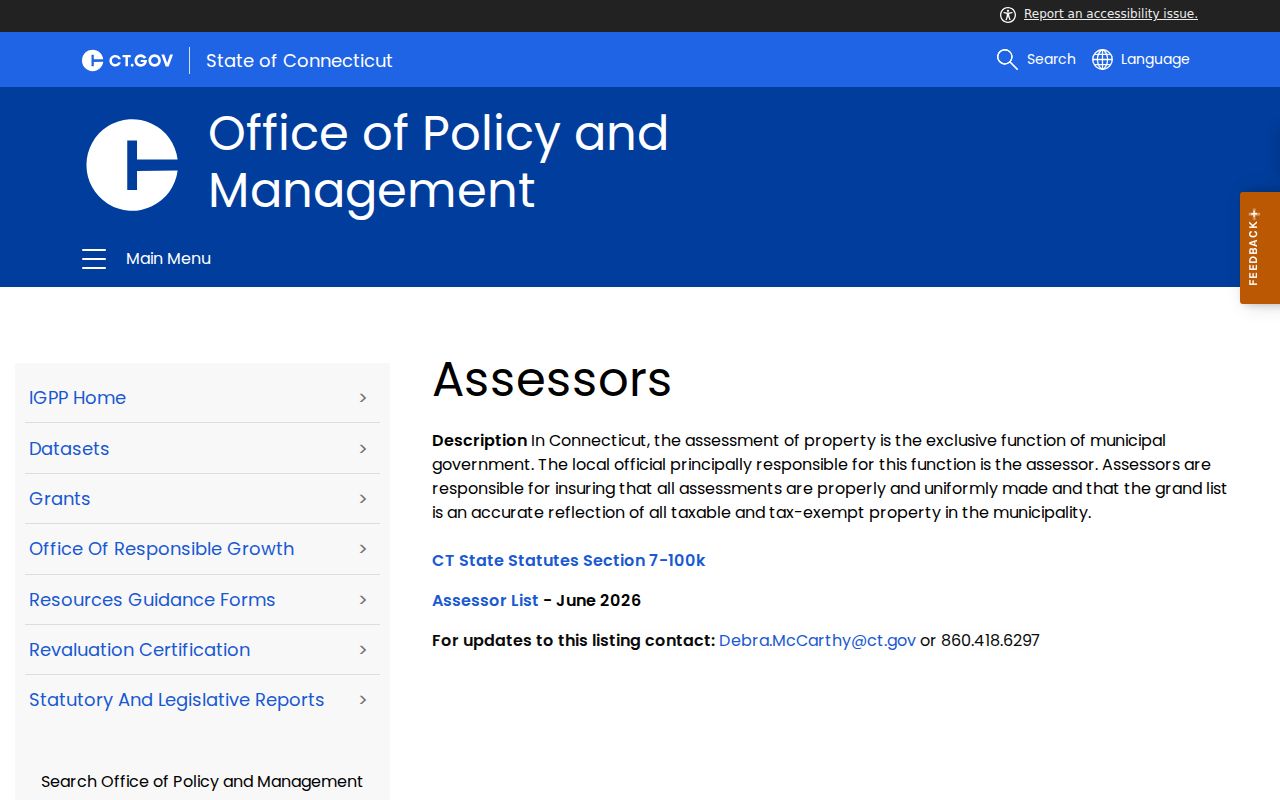
The directory identifies a town contact; the property card and its search fields stay local.
Connecticut Assessor Owner Fields and Parcel Keys
Each municipal assessor decides how its public card shows the owner name and account details. Search options and field labels vary by vendor. A representative East Hartford assessor search offers Property Location, Owner Name, and CAMA ID modes. That town is a local example. It is not a promise that every Connecticut town uses the same screen. Nor does every town accept the same query.
| Assessor control | Type | Requirement and note |
|---|---|---|
| Search By | Mode selector | Required; visible modes are Property Location, Owner Name, and CAMA ID |
| Property Location | Text or structured fields | Mode-dependent; use the local situs spelling and town |
| Owner Name | Text | Mode-dependent; results are local to the municipality |
| CAMA ID | Text | Mode-dependent; copy the exact local identifier |
An owner result is easier to verify when it comes with a parcel identifier. Connecticut towns label that key in several ways. It may appear as CAMA ID, property ID, account number, map/block/lot, list number, or parcel number. There is no single public APN format across municipalities. Preserve the exact local spelling, town prefix, hyphens, and leading zeros. That way the same parcel can be traced through GIS, tax, and clerk records. The East Hartford search screen shows its entry modes. Each town's live result card can differ.
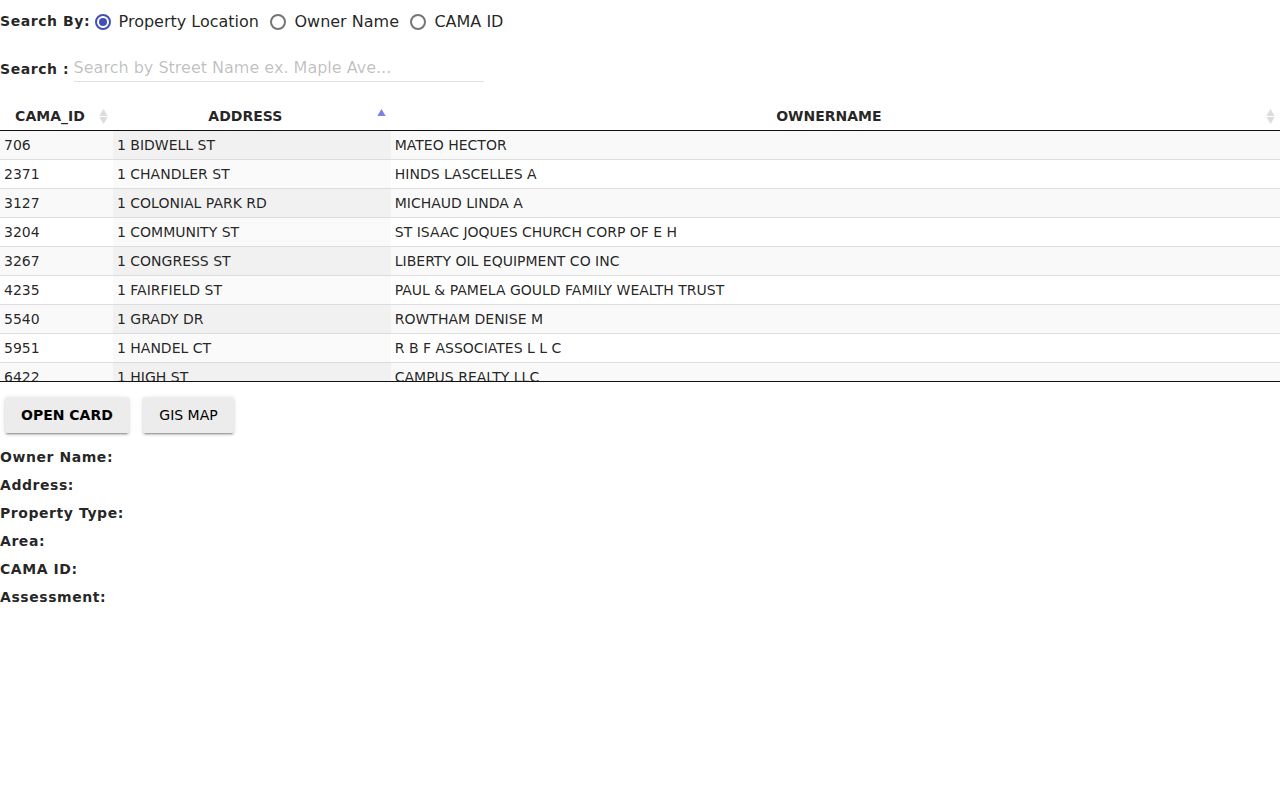
Use the municipal assessor's own result to link an owner's name with a Connecticut parcel. Record the result date and the local account key along with it.
Does a portal offer no usable card? Contact the municipal assessor. Or request inspection or a copy under Connecticut's Freedom of Information Act. A request should name the town. Include the parcel or situs, the record type, the date range, and the preferred format. No statewide special form is required, though the agency may have a local one. The local office also controls the practical route for a copy or scan.
Where Connecticut Property Owner Records Appear
No single Connecticut database merges the assessment roll, the recorded deed, and the parcel map into one official answer. Each custodian contributes a piece. The town clerk's index is permanent and public. The assessor and GIS supply parcel-linked descriptions that vary by municipality or data source.
| Connecticut source | What it can show | How to use it |
|---|---|---|
| Municipal assessor | Owner field, situs and mailing addresses, parcel/CAMA key, assessment details | Town portal, assessor office, or public-record request |
| Town clerk land-record index | Grantor and grantee, instrument type, received date, book/page or document reference | Town portal, clerk counter or terminal, or written request |
| Municipal or regional GIS | Parcel shape, local identifiers, and selected map attributes | State, COG, or municipal viewer; discovery and matching |
| Business Records Search | Entity name, ID, principal, agent, formation date, type, and address | Online name, ALEI, or filing-number search |
Connecticut keeps the assessed owner, deed grantee, and tax-mail recipient in distinct records, and a map helps locate the parcel without replacing either source.
- Owner of record
- The party named on a public assessment or land-record entry for the parcel.
- Grantee
- The person or entity receiving an interest in the recorded instrument.
- Title
- The legal rights reflected in land instruments; an assessor name alone does not settle title.
- Situs and mailing addresses
- The parcel's physical location and the separate address used for tax correspondence.
Confirm a Connecticut Owner by Deed
Land records in Connecticut live at the town level, and every town clerk keeps them. Under CGS § 7-25, the clerk enters grantors and grantees in alphabetical indexes. The clerk also cross-indexes parties. The record notes the instrument type, date received, and book/page or approved location. The entry is due within five days of receipt. The general index is a permanent public record. An electronic system under § 7-25a combines the grantor and grantee indexes.
Start with the assessor's latest-sale deed reference. If none appears, search the grantee name in the municipality's clerk portal. Narrow by date or instrument type where the vendor allows. Read the instrument's full legal description and party capacity, not just the index line. Deed images vary by town. One may be online, limited to an index result, or gated by portal access terms.
Connecticut towns are switching record systems. They are moving from the legacy Town Clerks Portal to Cott RECORDhub. The active system depends on the municipality. When a search, an image, or an older volume is not online, the current town clerk remains the fallback.
An index hit names an instrument to inspect. It does not name an occupant or every interest in the land. For deed detail, use the Connecticut deed-records reference.
Connecticut LLC, Trust, and Estate Owner Names
An assessor card or deed may name an LLC, corporation, trustee, nominee, or estate. That name is the party carried in the record. It is not every person who benefits from or controls the arrangement. Read the deed's capacity clause. Then compare the parcel description. Only then draw a conclusion about the owner of record.
For business entities, Connecticut's Business Records Search takes a business name, ALEI, or filing number. Results can show an entity ID, principal, agent, formation date, type, and address. Annual reports appear as PDFs. An agent is not automatically the landowner. A filing is not proof of beneficial ownership.
An estate or fiduciary role can slip past an ordinary name search. The Probate Case Lookup offers a case index, but document access has separate limits. Foreclosures are a separate track. If one appears, check the Judicial Branch civil inquiry. The docket is context; the town clerk's deed is the land-transfer instrument.
Why Connecticut Owner Names Differ
Connecticut assessment, tax, and recording workflows update on different schedules. A deed can hit the clerk's index first. The assessor's next grand-list refresh may lag, so the roll can still carry an earlier name after a recent transfer. Note the assessor's record date and the clerk's received or recorded date separately.
The October 1 assessment date is statewide. Towns control their own cards and data updates. A tax bill also follows a municipal account and mailing process, not a real-time certificate of title. When the assessor card cites a deed book/page or document number, use it to locate the instrument and compare the situs and legal description. Otherwise search the town clerk by grantee and date.
Online access varies by town. Some portal entries give index data without images. Clerk pages often list separate starting points for indexes and images. A stalled search is not the end. Ask the clerk about older volumes or a public terminal, because an incomplete online result does not prove that no deed exists.
Limits of a Connecticut Property Owner Search
A Connecticut owner lookup identifies roles in the public record, not household facts. The assessor's mailing address shows where tax correspondence goes. It is not proof of residence. The situs address identifies the parcel location. A deed's grantee is the party named in that instrument. A GIS label can rest on a separate data snapshot, and none of these alone establishes occupancy or a private beneficial interest.
Some owners' home addresses are suppressed under CGS § 1-217 or handled through the Safe at Home Address Confidentiality Program. The OPM parcel/CAMA guidance says parcel data may substitute a generic “Current Owner” label or the parcel location for a protected address. A blank or standardized field can be intentional. It marks a privacy limit. Connecticut rules do not authorize rebuilding a protected residence from unrelated records.
Keep to the public parcel, assessment, and deed information. If the official record is suppressed, incomplete, or ambiguous, use the custodian's request process. Preserve the uncertainty in your notes.
Respect the record boundary. An owner's public name is not permission to track a person or republish protected details. Stop at a suppression notice and use the official custodian route for a lawful record question.