
Read Connecticut's Owner-of-Record Card
A Connecticut assessor card ties an owner name to a municipal parcel and account. Field labels vary by town. Copy each label, its value, and its date together. The OPM parcel/CAMA schema and local cards place owner fields beside mailing and situs addresses, a parcel key, assessment values, and a sale or deed reference.
| Owner / Current Owner | The exact public name or standardized label on the local card |
|---|---|
| Mailing Address | The address used for tax correspondence; it can differ from the parcel location |
| Situs / Property Location | The physical location assigned to the Connecticut parcel |
| Parcel or CAMA ID | The town's local identifier for matching assessment and map records |
| Assessment and List Date | The value fields and the date or grand-list year they describe |
| Sale / Deed Reference | A sale date or book, page, or document reference when displayed |
The owner-of-record field is carried on that assessment card. It is not an occupancy statement. Nor is a tax-mail address a residence finding. Connecticut assessors can show a generic “Current Owner” label when a protected name is suppressed. A suppressed name still leaves the parcel account itself intact.
Note: The Connecticut owner field is a dated local record rather than a statewide title certificate. Compare its date with the deed.
Connecticut Assessor Searches Show Local Fields
The OPM assessor directory routes each Connecticut property question to a municipal office. Search modes vary by town. The East Hartford assessor portal shows one local layout. Its screen offers Property Location, Owner Name, and CAMA ID searches, while other towns use different vendors, labels, and result layouts, so the statewide directory is a starting point rather than one statewide owner database.
| Search field or control | Type | Requirement and note |
|---|---|---|
| Search By | Mode selector | Required; visible choices include Property Location, Owner Name, and CAMA ID |
| Property Location | Text or structured fields | Mode-dependent; use the local situs address and spelling |
| Owner Name | Text | Mode-dependent; search is local to the municipality |
| CAMA ID | Text | Mode-dependent; enter the exact local identifier |
The East Hartford search screen offers a local look at owner and parcel search modes.
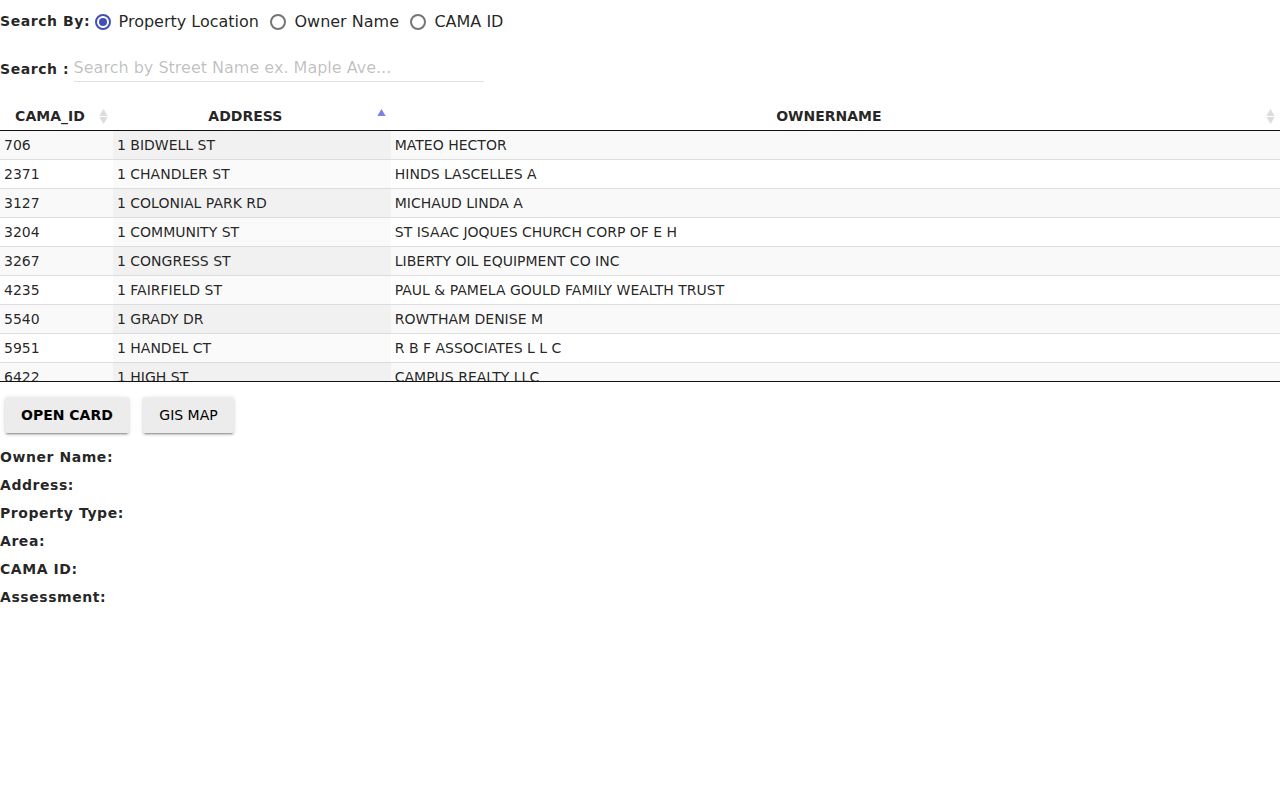
That search screen is only the entry point. The live result supplies the owner fields and dates. When a Connecticut owner card is not online, contact the municipal assessor or request inspection or a copy under the Freedom of Information Act. Name the town, parcel, record type, and date range. The local office may ask for its own form before it releases the record.
How Current Is a Connecticut Owner Record?
Connecticut sets the assessment date at October 1. Each municipal system sets its own posting and correction schedule. So the roll can keep showing an earlier name after a newly recorded conveyance. The assessment record stays useful for the parcel and its roll status. But its date must be compared with the town clerk's land-record index.
A purchase does not reset an assessment to its sale price. Municipal mass appraisal governs instead. State law bars a change based on one sale alone. A card may list sale history. But the clerk's deed verifies the grantee and the land description.
Write down the assessor's list date. Add the deed's received date. If the deed is newer, treat the roll as a dated snapshot. It is not a real-time certificate of title.
Confirm a Connecticut Current Owner by Deed
The town clerk's index checks the roll. Under CGS § 7-25, grantor and grantee names must be indexed within five days of receipt. Instrument type and book/page go in as well. Portal fields vary by town. Use the assessor's sale reference when shown; otherwise search the town's grantee index by name and date.
- Record the Connecticut assessor's displayed owner, parcel key, situs, and card date.
- Open the relevant municipal clerk portal and search the latest grantee entry or the card's deed reference.
- Compare the instrument's grantee, recording date, and legal description with the assessor parcel.
- Use the clerk's public counter, terminal, or written request route when the index or image is not online.
- Owner of record
- The name displayed in a public assessment or land record for the parcel.
- Assessment roll
- The municipal list that carries property values and owner fields for a stated assessment date.
- Situs and mailing address
- The parcel's physical location and the separate address used for tax correspondence.
- Recording lag
- The gap when a deed appears in the clerk's index before the assessor's next roll update.
- Grantee
- The party named in a deed as receiving an interest in the parcel.
Read the entire deed when an image is available. The legal description matters as much as the names. A name-only match can point to the wrong parcel or a same-name party. For a complete address-to-record route, the Connecticut property owner lookup method explains how the assessor, deed, and parcel key fit together.
Connecticut Owner Mailing and Situs Addresses
The situs address tells you where the parcel lies. The mailing address tells you where tax correspondence goes. They often differ. Connecticut records may show an owner living elsewhere, a business mailing address, a trustee's address, or a standardized location in place of a protected one. None of those entries proves who occupies the property.
Compare four items separately: assessor situs, tax-bill mailing address, deed description, and postal address. A ZIP code can cross town lines. A postal city can differ from the municipality, and one parcel can carry several street numbers or a condominium unit. If the fields do not line up, use the town and local parcel identifier to confirm the records describe the same land.
Start that check before chasing the current owner. A tax mailing address identifies an account record. It is not proof of residence. It is also not a reason to seek out private contact details for the person named on the roll.
When a Connecticut Record Names an Entity
A Connecticut deed or assessor card may name an LLC, corporation, trustee, nominee, or estate rather than a person. The owner field shows the public party. It may not name the person who benefits. Read the capacity clause closely, and compare the deed's legal description against the parcel.
The Secretary of the State's Business Records Search accepts a business name, ALEI, or filing number. Results can show the entity name and ID, principal, agent, formation date, type, and address, plus annual-report PDFs. That confirms a named business exists. It does not make a principal or registered agent the owner of the land, or reveal the beneficial person behind a trust.
Estate and fiduciary records differ. The probate record may use a role that a personal-name search misses. The Probate Case Lookup is an index, with limits on document access. For foreclosure context, use the Judicial Branch civil inquiry. The town clerk's deed governs the transfer.
Connecticut Deed Images Have Different Cutoffs
A current-owner check leans on the newest relevant deed. Online access to indexes and images varies from town to town. The legacy Town Clerks Portal is moving municipalities to RECORDhub. Its roster flags some entries as index-data-only. Local clerk pages may also start images later than indexes. An index hit without an image is an access gap, not a reason to treat the assessor card as deed confirmation. Resolve the gap with the clerk.
Bethlehem's clerk page reports a land index beginning in 1937 and images beginning in 1946. Redding's clerk page puts both online index and image coverage at 1969, noting image availability in its search route. The two towns tell the story. Coverage dates must be checked locally. Some latest deeds need a terminal or clerk request.
Check the legacy portal, RECORDhub, or the municipal clerk page for the active route. For instrument fields, see the Connecticut deed-records page.
Note: An online index result and an image differ in coverage; ask the municipal clerk when a document is not viewable.
Protecting a Suppressed Connecticut Owner Record
Connecticut law lets certain protected people suppress a home address in public records. The Safe at Home Address Confidentiality Program gives eligible participants a substitute mailing address for covered interactions. State parcel and CAMA materials also describe standardized substitutes for the "Current Owner" field when owner data is suppressed. A generic label is not proof of missing data. That label is common on assessor cards. It may simply be the public-facing privacy treatment.
Each program publishes its own rules. See the Secretary of the State's privacy information for the voter file and the Safe at Home program page for address confidentiality. Property suppression is distinct from the voter file. A substitute address is not an invitation to hunt for a protected residence through unrelated records.
The Connecticut Data Privacy Act covers certain personal-data processing. It does not erase every government land record or override other laws. A lookup should preserve a suppression notice and stop at the public field. Never try to reverse it.
Note: A privacy substitute is a data limit, not an opening to search for the protected residence through other records.
Contact Limits for a Connecticut Property Owner
A public owner-of-record entry supports parcel research and verification. Treat it as a starting point. It does not prove anyone lives at the site. Nor does it promise a mailing address is current, or that an individual behind an entity appears anywhere in the public record. Note the Connecticut source, the access date, the parcel key, and any gap between the assessor roll and the clerk's deed entry.
When a record is protected, use the custodian's official request route. If names or dates disagree, mark the evidence incomplete. Then check the clerk or assessor. The current owner turns on the parcel and the newest instrument, not a map label or tax-mail contact.
Check the newest deed. The assessor roll can lag a recent sale; the newest relevant town-clerk deed is the more current recorded owner entry. Keep a suppression notice in place and do not republish protected details.