
What a Connecticut Property Value Number Represents
One Connecticut assessor card can carry an assessed figure and a fair-market estimate. It may also show a prior sale amount. Related numbers, but not interchangeable ones. OPM's framework and Chapter 203 place assessment and taxation with municipalities. The local card records the assessment used for that town's grand list. A deed records a conveyance. Some systems also show market estimates, sale history, and separate land and improvement amounts. The exact fields vary by town.
| Value | What It Is | Where |
|---|---|---|
| Assessed value | Grand-list value used in the local tax calculation, subject to phase-in or special treatment | Municipal assessor |
| Fair-market estimate | Assessor’s estimate where the town’s card or vendor displays one | Municipal assessor |
| Last sale consideration | Amount reported for a prior conveyance, if recorded or displayed | Deed and sometimes assessor sale history |
| Land and improvements | Separate components that contribute to the total assessment | Municipal property card |
CGS § 12-62a generally sets Connecticut assessments at 70 percent of present true and actual value. That is fair-market value by another phrase. The ratio does not turn the assessor's figure into a sale quote. A phase-in or a special statutory valuation can shift the ordinary relationship too. Wherever a number goes, its date, field label, and municipality should travel with it.
Connecticut Property Value and the Assessment Level
Under CGS § 12-62a, the assessment is normally 70 percent of the assessor's fair-market value. Valuation rules sit in § 12-63. The ratio is a statewide assessment framework. It is not a claim that each parcel's displayed number is a fresh appraisal. A municipality's grand list, property class, valuation date, and any phase-in or special treatment explain how a particular card relates to the broader rule. The displayed market and assessed figures may not appear to match. Then consult the town's record.
The statewide property-assessment statutes lay out the legal structure. The Office of Policy and Management's assessment and taxation materials state that these functions are administered locally. Together they explain why Connecticut has a common framework but no single statewide parcel-value card.
Find a Connecticut Assessed Value by Address
Start with the municipal assessor. Connecticut offers no single portal that replaces all town systems. The OPM directory of municipal assessors is the statewide routing point. Once on a town's assessor page, search by the property location or the exact local parcel and CAMA key. Do this if the system supports it. Treat the displayed valuation year and field names as part of the result. They matter, not just the number itself.
- Confirm the legal municipality from the parcel’s situs or recorded description; a postal city name alone may point to a different town.
- Use the assessor’s official page to search the address, then preserve the parcel identifier exactly as displayed.
- Capture the grand-list or valuation year, land value, improvement value, total assessment, and any market estimate the record provides.
- For the last transaction, use the assessor’s sale reference as a lead and verify the conveyance in the town clerk’s land records.
No single statewide APN format exists. A town may call its key a parcel number. It may also use a CAMA ID, property ID, account number, or map/block/lot. Copy hyphens and leading zeroes rather than recasting the identifier. A split parcel, condominium unit, or changed address causes trouble. An old ID or street number can point at a different assessor entry. If no usable card is online, contact the municipal assessor. Ask for the property card and the date of the current grand list. Connecticut's FOI Act also allows prompt inspection. It also allows a copy of records a public agency already holds. The FOI Act text and FOIC guidance explain the request and appeal route. A local form may be offered. The statewide materials do not require one standard form for every request.
- Assessed value
- The grand-list figure used for municipal taxation, generally set at the statutory assessment level unless another treatment applies.
- Fair-market estimate
- The assessor’s estimate of full value where the local property card displays one.
- Level of assessment
- The relationship between assessed value and fair-market value under the statewide assessment framework.
- Sale consideration
- The amount associated with a recorded transfer when stated or available in the assessor’s sale history.
- Valuation year
- The date or list year that identifies which assessment snapshot a displayed figure belongs to.
Connecticut Assessment Components: Land, Building, and Total
A municipal card may separate land from buildings or improvements before showing a total assessment. The statewide sample parcel-card inventory identifies fields that can appear locally: property class, use code, lot size, year built, living area, sale history, and a property sketch. It is a field checklist from Connecticut's assessment research. No guarantee comes with it that every town's public screen exposes every item. Before comparing two records, confirm both describe the same parcel and list year. A condominium main parcel and its units can be distinct records. A split or merged lot may carry a new parcel identifier. A changed total might come from different land or improvement entries, a new parcel configuration, or a different valuation cycle. Never assume the whole change traces to the building or to a recent purchase.
Connecticut Assessed Value Fields and Data Dates
Municipal value cards do not follow one public layout across Connecticut. Capture the field name and its year. A good record shows land assessment, building assessment, and total. Some cards add a property class or use code. Others show a fair-market estimate and an exemption or special-use notation. Some also list the last sale date and reported consideration. Not every card shows every item. A blank field proves nothing. It does not mean the value or transaction is missing from another official record.
A displayed exemption can change the taxable assessment without touching the reported sale consideration. Follow the municipal notice and collector instructions for eligibility, bills, or appeals. The value card is not a benefits guide.
The state's Parcel and CAMA schema also calls for metadata. The list includes source, editor, capture date, and last-edit date. It also covers parcel type and a join field tying map geometry to the assessor account. Those data dates explain why two public screens can disagree. Parcel geometry and the valuation card may come from different update cycles. Preserve the source and capture date with any copied figure. Otherwise the number stops being a dated Connecticut property value and becomes something vaguer.
For a fair comparison, hold several things constant. Keep the municipality, parcel configuration, property class, list year, and valuation field the same. A total assessment from one grand list will not compare cleanly with a current estimate. It also will not match a different condominium unit. Labels matter. When a number lacks a date or field label, ask the local assessor for the record context.
Connecticut Revaluation Dates and the Grand List
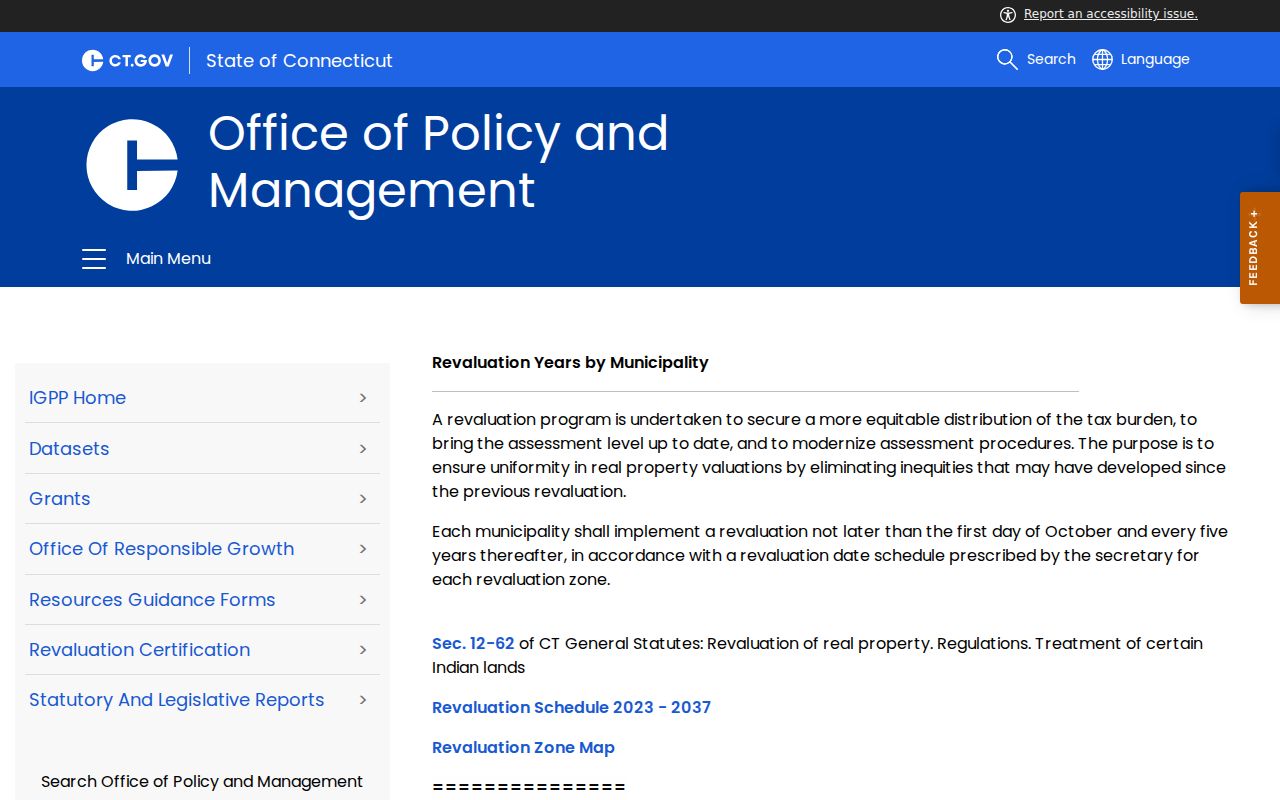
October 1 anchors every Connecticut assessment. Towns must revalue on a statutory schedule, generally every five years. OPM publishes a revaluation date by municipality. Find the town and its effective list year there. Then match that year to the assessor's card. The statewide schedule shows the planned cycle, not a parcel's history or current value. A town may phase in a revaluation increase over as many as five years under CGS § 12-62c. In a phase-in year, the displayed assessment can sit below 70 percent of the newly revalued fair-market figure. Read the schedule and the property card together. Comparing an old card with a current market estimate invites error unless both dates and the town's phase-in policy are known.
The OPM municipal schedule page serves as a guide to cycle timing. Its entries help locate the relevant assessment year. The local assessor still holds the parcel's actual record.
A neighboring card can look very different. So can a recent sale price. Match the dates. OPM and the Councils of Governments have also improved statewide parcel and CAMA discovery, though submissions vary in completeness and freshness. The OPM parcel and CAMA page describes the dataset and its metadata; for one property, use the municipality's current card and note its capture date.
Why Connecticut Sales Do Not Reset Assessment
One sale price cannot change a Connecticut parcel assessment. CGS § 12-63d bars it. A reported transaction can still inform mass-appraisal analysis and revaluation studies. Buying a property does not reset its assessor card to 70 percent of that consideration. Keep the sale date and price as transaction facts. The assessment remains the municipality's figure for its applicable grand list.
Depending on the town's vendor, an assessor card may show sale history or a deed reference. The recorded transaction itself belongs to the local town clerk's land records. Confirm the instrument and the stated consideration there. Some deeds and local result cards hide sale fields. A blank price on one screen proves nothing.
An assessor may weigh a transaction in mass appraisal. One closing does not settle what every comparable parcel should be worth. Check the conveyance date, assessment date, and parcel description before relating an assessment to the last sale. The recorded price is a historical fact. The assessment is a municipal valuation for its list year.
Connecticut Assessment Cases and Court Records
An assessment challenge can land in court. A docket and an assessor card serve different purposes. Connecticut Superior Court handles these appeals. Assessment disputes sit among the other property cases on its docket. Its civil inquiry portal, the official starting point for a public civil case lookup, locates litigation by party, docket, or supported address search. A case record shows court activity, not parcel valuation.
Keep a docket's filing date and status separate from the grand-list year on the property card. A case may explain a contested valuation. It cannot replace the municipal record, court orders, or any later assessment update without context. Docket entries are not assessor figures. Treat one as current only if the final disposition and updated record support that conclusion.
Historical Connecticut Assessment Cards and Tax Lists
Old assessment cards and tax lists open a window onto the past. They show how a parcel changed over time. A few Connecticut State Library collections show the range. Bethlehem property cards run from 1969 through 2003. Sherman cards run from 1969 through 2008. Windsor records reach back to 1886 and run to 1991. Wallingford has a 1991 card collection, and town tax abstracts survive from even earlier periods. None of this forms a statewide series. Local holdings vary town by town. One town's gap is not proof a value never existed.
The State Library town-documents guide lists tax lists and similar municipal records. Ask the town first whether a card or list still survives. A historic assessment is useful for tracing property records. Just keep its date and purpose attached to any figure you pull from it.
Limits of a Connecticut Assessed Value
An assessed value is not an appraisal of one house. It is a municipal figure. It is built under Connecticut's mass-appraisal and revaluation rules for the grand list. A recorded deed reflects one sale on one day. The assessment reflects the town's valuation work instead, often keyed to a different date entirely. Neither number is a guaranteed resale price or an offer. And no value field settles title questions or fixes a boundary. It also does not tell you the current balance on a tax account.
Assessment is not appraisal. A Connecticut assessed value is a tax-roll figure, not a promise of what the parcel would sell for and not an appraisal for a transaction. Use a qualified valuation professional when an individual appraisal is needed.
The bill, exemption, and appeal side of the same record is covered under Connecticut property tax records. Those account questions belong with the municipal collector and the assessor's current notices.