
Tracing Former Owners in Connecticut
Connecticut keeps its land history local. The town or city-town clerk holds each deed index. A grantor conveys the interest; a grantee receives it. The State Library preserves selected early deeds, town documents, maps and assessment material, though no statewide table lists every town's earliest deed book or digital-image start. Treat the ranges below as examples, then ask the custodian for that town's index and holdings.
| Source | Years It Covers | Where Held | What It Shows |
|---|---|---|---|
| Town clerk deed index and images | Town-specific; Bethlehem index from 1937 and images from 1946; Redding from 1969 | Municipal clerk and its current portal | Indexed parties, instrument dates, record references and available deed images |
| Paper and microfilm land books | Older than each town’s online cutoff; ask the clerk for its range | Town clerk, with required microfilm copies | Earlier grantor/grantee entries and recorded instruments |
| Connecticut Archives land records | Guide coverage includes 1640–1846 | State Library / State Archives | Early deeds and land records; exact town holdings need catalog confirmation |
| Historic tax lists and property cards | Examples include Norwalk abstracts, 1812–1814, and Bethlehem cards, 1969–2003 | State Library or local assessor | Names and assessment context by year, not a substitute for a deed |
| Filed maps and subdivision plats | Town-specific; Bethlehem reports map records from 1928 | Town clerk, regional viewer or archive | Lot labels, survey references and recorded plan context |
Begin with the latest recorded deed. Follow its prior reference while the online index supports the chain. When digital images end, the paper trail begins. Shift to older index books or microfilm. A filed map can reconcile lot names, and historic assessment material bridges old names, addresses and years. A source's date range describes access, not proof that every earlier transfer survives.
Connecticut Former Owner Deed Chain
The assessor's owner field or sale reference locates the newest deed. Read the instrument itself. Never trust the index line alone. The grantee receives; the grantor conveys. Each prior reference can reach an earlier transfer, but probate, fiduciary, foreclosure or entity changes may interrupt a simple name-to-name sequence.
- Record the parcel’s municipality, current assessor name, legal description (written description of the land) and most recent deed reference.
- Find the deed with the current party as grantee; compare the parcel description, execution date and recording reference.
- Take the earlier grantor name and search that party as grantee in the preceding time period.
- Repeat with initials, alternate spellings, former names, trusts or entity names as the deed indicates.
- When the online index ends, continue in the town’s paper or microfilm index and note the source for each link.
- Grantor
- The party named as transferring the described interest.
- Grantee
- The party named as receiving that interest.
- Chain of title
- The ordered sequence of recorded conveyances for the parcel.
- Legal description
- The land description used to tie an older deed to the parcel when a street address has changed.
The legacy Connecticut Town Clerks Portal shows the older online access route and its transition notice. A portal change is an access boundary. It is not the start of ownership history.
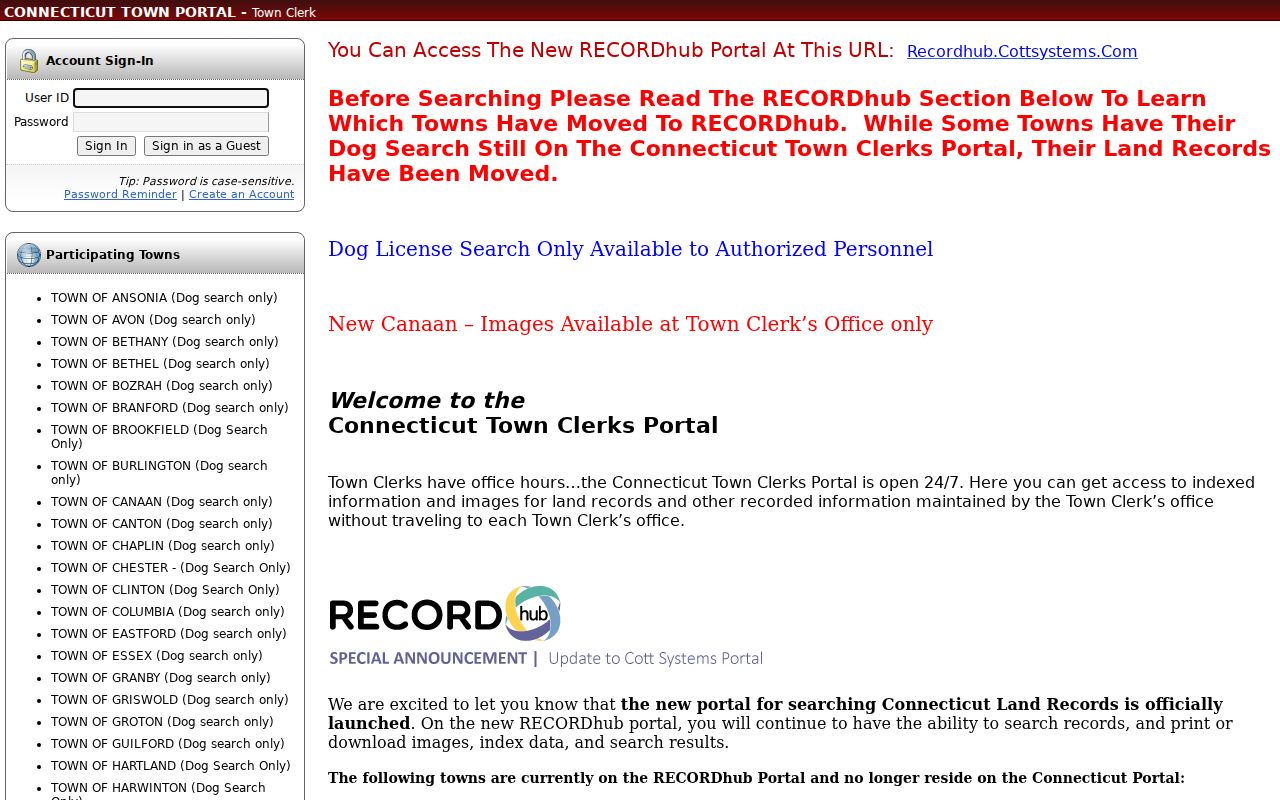
The town clerk's page confirms vendor and index range.
Connecticut Former Owner Name Variants
Names shift across decades of Connecticut land records. Search grantor and grantee sides separately. Then try a middle initial, surname-first order, a married name, an abbreviation, a trustee capacity or a corporate spelling. One deed may show an estate or entity where another shows an individual. Keep the exact spelling and party role from each instrument.
Never link two people just because names match. Compare the land description, municipality, date and prior recording reference. If a portal truncates an entity name, use the full name from the deed and check the business filing when a merger or assumed name explains it. The recorded instrument provides the property link. A name search alone does not.
Connecticut Historic Deed Maps
Older deeds often skip street numbers. They cite a farm, brook, or neighbor. A filed subdivision map supplies the lot labels. Those labels connect old wording to later records. Connecticut law requires a map index entry to list title, owners, filing date, survey date and a brief plot description. Match that reference to the deed and assessor parcel instead of assuming modern geometry matches the historical plan.
A recorded map is not a current survey. It shows the plan and easement context it contains. Town clerk map books, regional GIS viewers and State Library collections can help locate the referenced plan. If the deed names a map, record its town, map number, filing date and lot name. A later search can return to it.
Connecticut Paper and Microfilm Deeds
Connecticut towns must keep paper land records. The rule holds even with electronic recording systems. The State Library's 2023 Public Records Memorandum 103 describes paper daybooks, collated indexes, recorded documents and microfilm duplicates of land records. So a portal cutoff often signals a format or custodian change, not a lost volume.
When the online chain stops, gather details first. Bring the clerk the last book and page. Add current and prior party names, the property description and spelling variants. Ask whether the older index runs alphabetically by grantor and grantee or by book. Ask whether it sits on paper, microfilm or scan. Access varies by town. It may come through a public terminal, counter inspection, phone guidance, a written request or Connecticut's FOI Act. If a town lacks a local image, ask about the State Library catalog and Archives record group.
The State Library land-record memorandum describes the preservation standards. It confirms one point. Older formats belong in every deed search plan.
Historic Connecticut Tax Cards and Directories
Old assessment cards, tax abstracts, and town reports can bridge the gap. A parcel name or street address may have changed over time. The State Archives holds examples. These include Plainville tax abstracts from 1869–1989, Suffield tax records from 1849–1969, Bethlehem property cards from 1969–2003, and Sherman assessor cards from 1969–2008. Those are selected holdings rather than a complete statewide run. For any given town and span of years, ask the State Archives. Or ask the local assessor what survives.
Directories and newspapers add household and neighborhood color, but they do not prove ownership. A directory places a name at an address in a given year. Yet it may not distinguish an owner of record from a renter. A missing entry could reflect a move, a death, street renumbering, or a publication gap. The State Library points to town reports starting around the 1850s, varying by town. It also offers further material through its History and Genealogy research portal.
Former Connecticut Owners through Estates
A transfer caused by death rarely resembles an ordinary sale between two people. The document tying the prior owner to the next grantee may be a fiduciary deed from an estate representative. It may instead be a certificate of devise or descent, or another estate paper. The town land records hold whatever was recorded. Probate files can add context. Older estate documents follow collection-specific rules for access and location, so rules matter here.
The State Library's historical and genealogy collections include probate records. Its finding guides point to town and district material. Search the estate name and the land record separately. Then confirm the deed's legal description and the stated authority behind it. When an old probate volume or image is restricted or unavailable, ask the probate clerk or the State Library. Do not guess from a directory entry.
Occupants and Connecticut Property Title
Former occupants and former owners are different questions. Census entries, city directories, newspapers, and school or town reports suggest who lived or worked at an address. A deed index works differently. It traces recorded transfers of the land itself. Keep separate notes so an address match is never mistaken for a title link in your property records work.
The Connecticut State Library describes directories, census records, annual reports, maps, and newspapers as useful historical collections. A directory's owner or renter mark depends on the publisher and the year. An obituary or public notice can hint at a transfer. Still, follow the hint back to the clerk or the probate file. Local history explains a parcel's story. The official record settles any ownership claim.
Former Owner Records in Connecticut
Connecticut deed records have no single statewide starting year. Each municipal clerk keeps its own books and indexes. The State Archives guide identifies early land records from 1640–1846. Digital coverage often begins far later. Selected state and local collections fill some historical gaps for property records research, but no town offers one online cutoff for everything. Treat the oldest verified holding as a boundary for that source. It promises nothing about earlier transfers.
For a modern recorded chain, continue with Connecticut deed records to find the local index and copy route. Who appears on the current assessor roll is a separate question. Compare that owner-of-record source on its own. Earlier occupants and prior grantees answer different questions. Cite deed links and gaps, never occupancy, as evidence of former ownership.
Use records for property history and lawful title research. Do not use an ownership trail to stalk, threaten, harass or expose protected personal details. Respect suppressed addresses and the limits of each source.